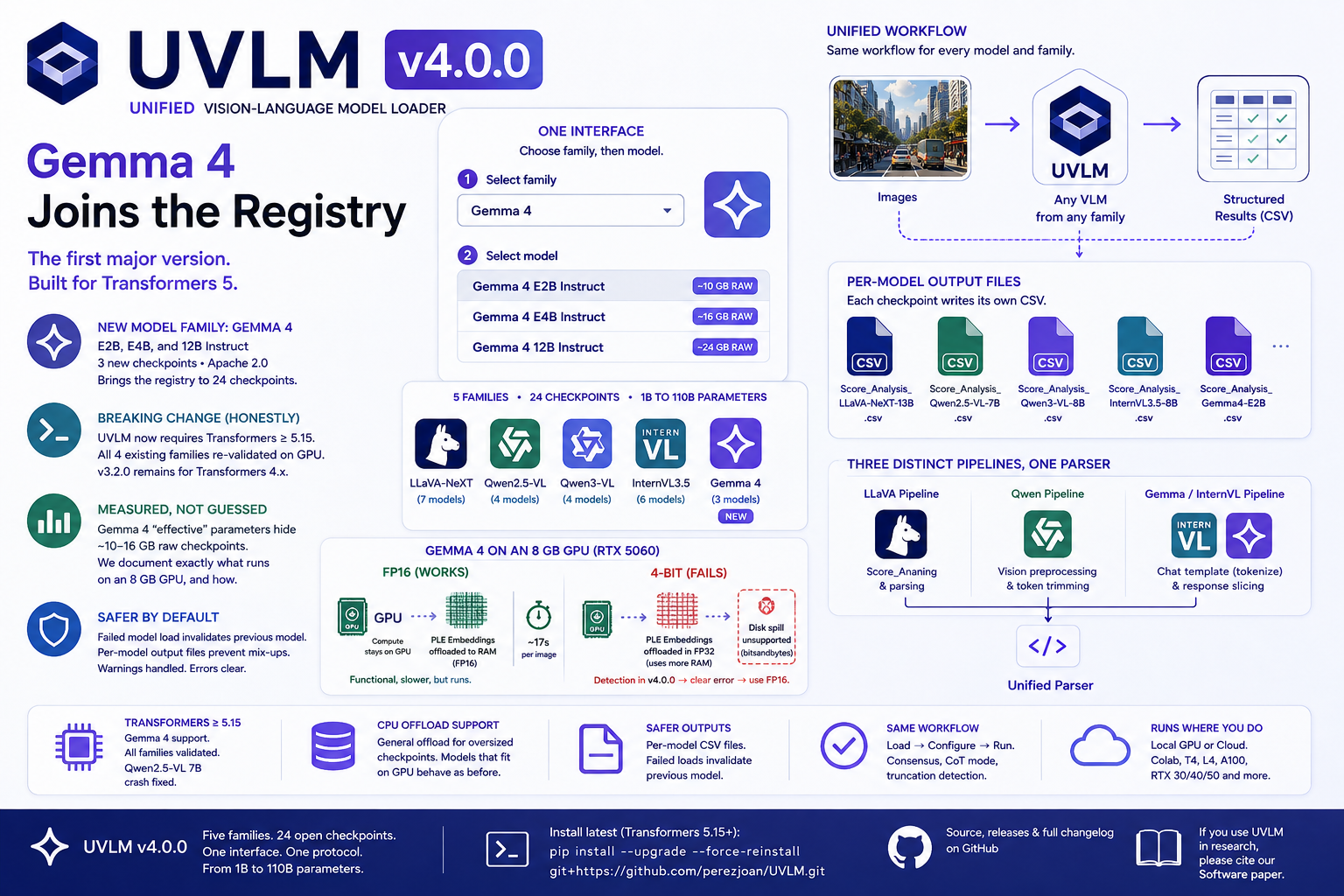
UVLM v4.0.0 — Gemma 4, the Transformers 5 Migration, and Why This One Is a Major Version
Highlights New model family: Gemma 4 (Google [...]
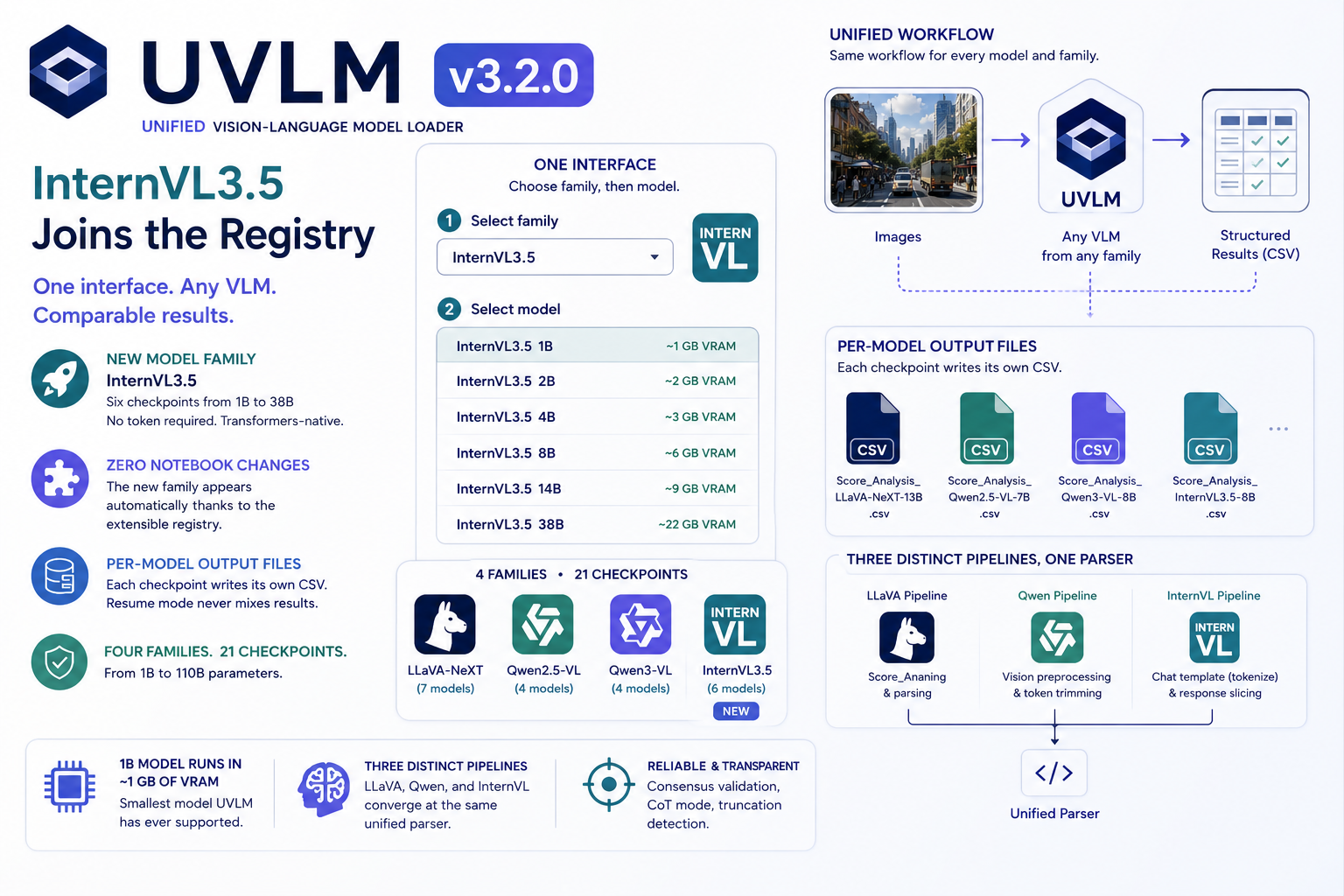
UVLM v3.2.0 adds InternVL3.5 (1B–38B, six checkpoints): 21 open VLM checkpoints across 4 families, one Python interface. The new family appeared in the notebooks without a single notebook edit — plus per-model output files for cleaner benchmarking.
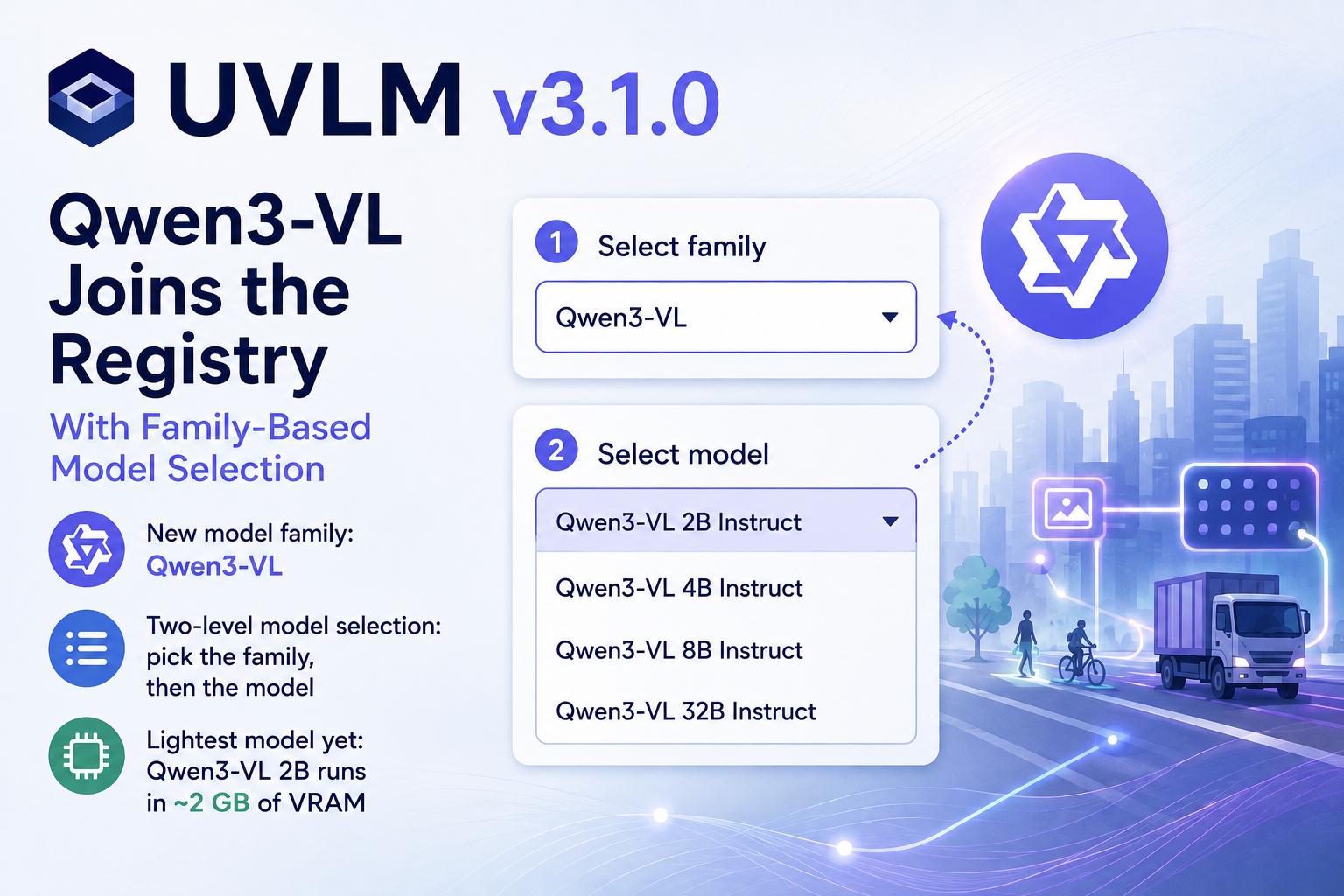
UVLM v3.1.0 adds a third model family, Qwen3-VL (2B–32B Instruct), bringing the registry to 15 checkpoints. The notebooks gain a two-level family/model selector, the loader picks BF16 automatically on capable GPUs, and the smallest new model runs in about 2 GB of VRAM. Same three-block workflow, same prompts, one more family to compare.
Run a capable large language model entirely on your own machine — private, offline, and with as little as 8 GB of GPU memory. This hands-on guide sets up a clean Python environment, gets CUDA working even on the newest NVIDIA Blackwell cards, loads a 4-bit quantized model from Hugging Face, and builds an interactive chat widget with conversation memory and a live VRAM gauge in JupyterLab. No cloud, no API keys, no data leaving your computer.
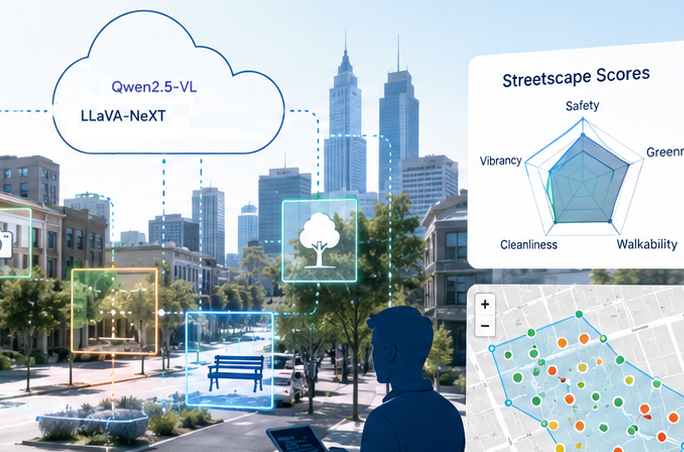
SAGAI v2.0 consolidates the full streetscape analysis pipeline into a single Google Colab notebook and replaces the inline LLaVA-only inference code with the UVLM package, enabling multi-model benchmarking across 11 VLM checkpoints. New features include a multi-task prompt builder, consensus validation with majority voting, chain-of-thought reasoning, truncation detection, interactive Folium maps, view-direction filtering, and support for loading existing polygons as study area boundaries.
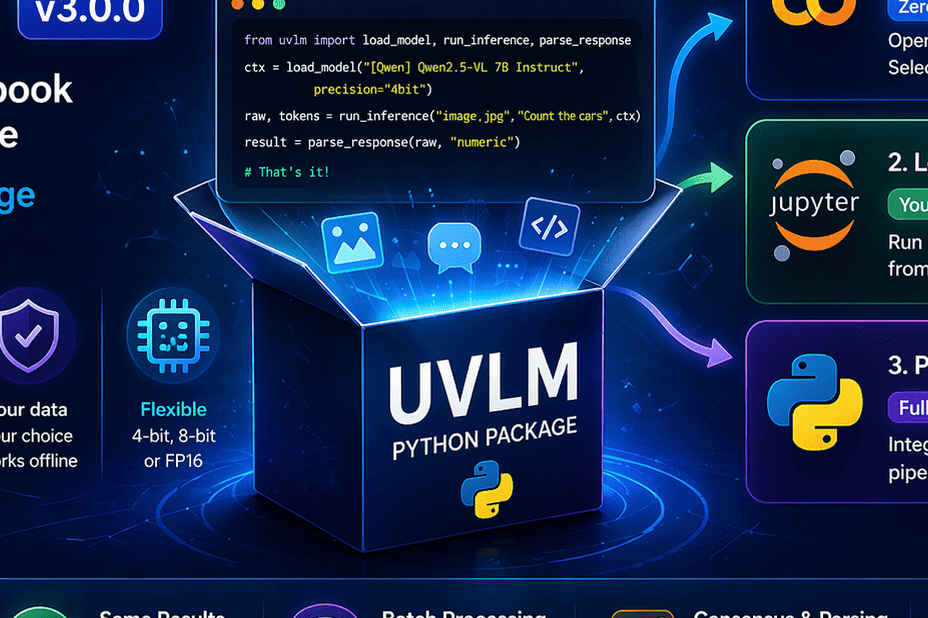
UVLM v3.0.0 turns a Colab notebook into a full Python package. Run vision-language models locally, in notebooks, or scripts with a simple API and no setup complexity.
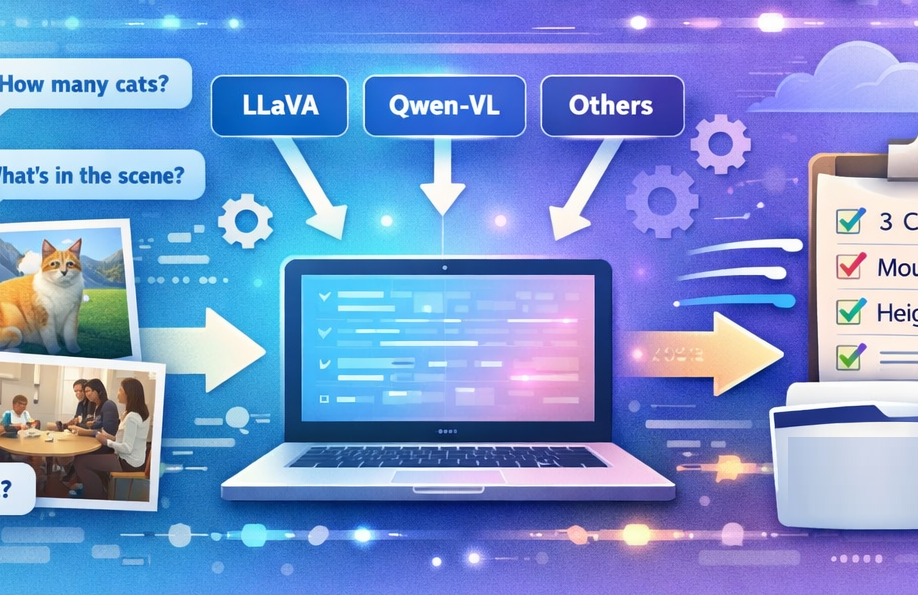
UVLM is a free, open-source tool for loading, testing, and comparing Vision-Language Models on custom image analysis tasks. Running entirely in Google Colab, it lets researchers and practitioners benchmark multiple AI models using the same prompts and images — no coding, no GPU ownership, no model-specific pipelines. This post explains what VLMs are, why comparing them matters, and how to get started in five minutes.
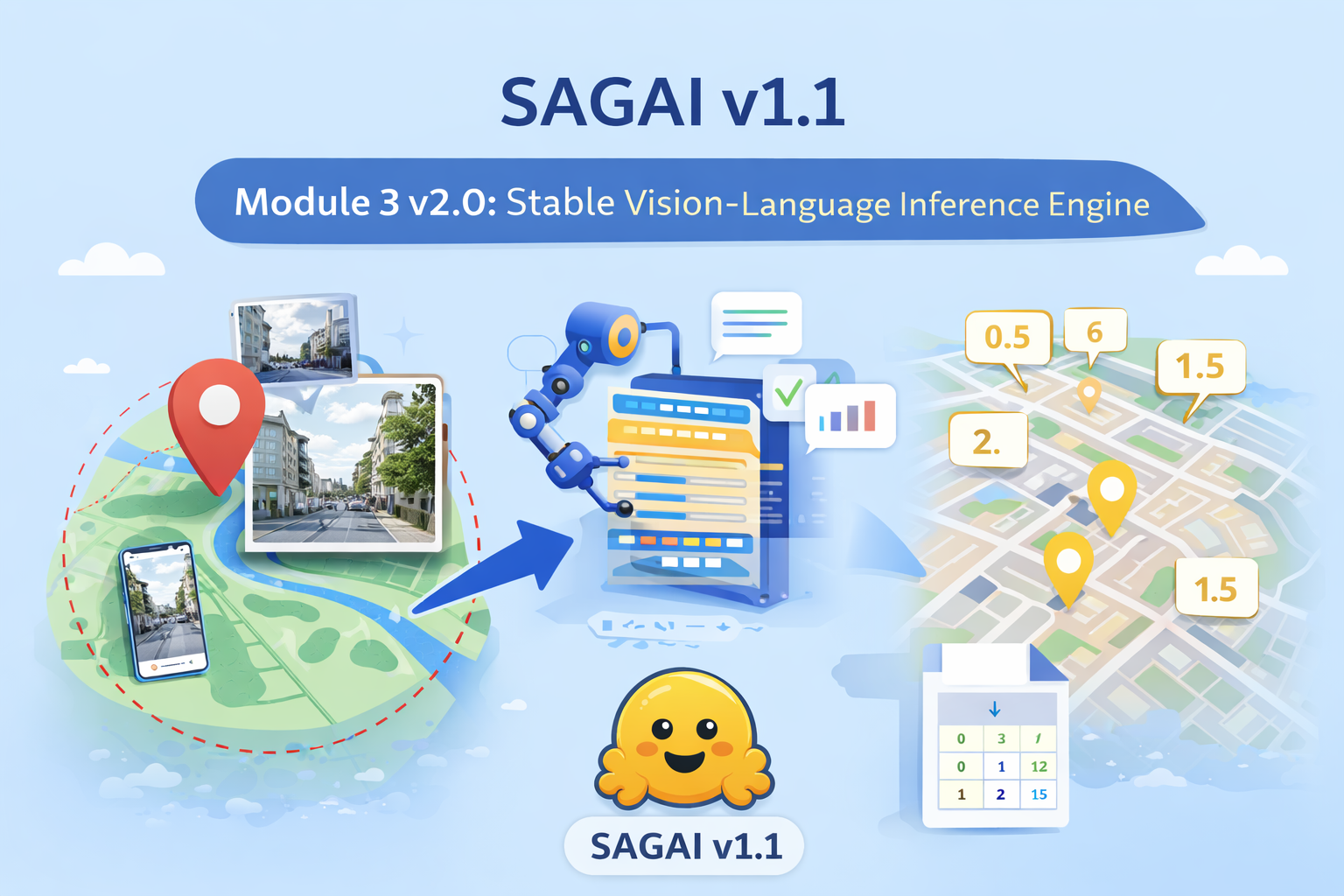
SAGAI v1.1 introduces Module 3 v2.0, a stable and reproducible vision–language inference engine for streetscape analysis. Built exclusively on Hugging Face LLaVA models, it enables robust multimodal processing of street-level images for large-scale urban and geospatial analysis.
Learn how to process geospatial data entirely in the cloud using GeoPandas, Google Colab, and Drive. Create, analyze, and save maps without local setup.
GeoPackage is an open and non-proprietary data format that allows different layers to be stored within the same file. In this post, we are going to read and save layers using python (geopandas) and R (sf).