
Highlights
- New model family:Qwen3-VL (released from September 2025) joins LLaVA-NeXT and Qwen2.5-VL
- Two-level model selection: pick the family first, the model list refreshes automatically
- Lightest model yet: Qwen3-VL 2B runs in ~2 GB of VRAM with 4-bit quantization
What is Qwen3-VL?
UVLM was built around one idea: compare Vision-Language Models across architectures using identical prompts and evaluation protocols, without writing model-specific code. Until now that meant two families: LLaVA-NeXT and Qwen2.5-VL. Version 3.1.0 adds a third: Qwen3-VL, the successor to the Qwen2.5-VL family that anchored our published benchmark.
Qwen3-VL is the latest vision-language generation from Alibaba’s Qwen team, first released in September 2025 with the 235B-A22B flagship, followed shortly after by the compact dense checkpoints that matter for most research budgets. UVLM v3.1.0 integrates the four dense Instruct sizes:
| Model | Parameters | VRAM (4-bit) | Typical hardware |
|---|---|---|---|
| Qwen3-VL 2B Instruct | 2B | ~2 GB | Any modern laptop GPU, free Colab T4 |
| Qwen3-VL 4B Instruct | 4B | ~3 GB | T4, RTX 3060 |
| Qwen3-VL 8B Instruct | 8B | ~6 GB | T4, RTX 4060/5060 |
| Qwen3-VL 32B Instruct | 32B | ~20 GB | A100, RTX 4090 |
The registry now totals 15 checkpoints across 3 families, from 2B to 110B parameters — and the 2B entry is the smallest model UVLM has ever supported, which makes it an interesting new baseline for large-scale, low-cost batch analysis.
Technically, Qwen3-VL keeps the Qwen inference conventions (chat template → separate vision preprocessing → generation → token trimming), so it plugs into UVLM’s existing Qwen pipeline. What changes under the hood: the model loads through Transformers’ generic AutoModelForImageTextToText class, requires transformers ≥ 4.57 and qwen-vl-utils ≥ 0.0.14, and resizes images to multiples of 32 pixels rather than 28. All of this is handled inside the package — from the user’s side, it is simply one more family in the dropdown.
Pick the family, then the model
With three families and fifteen checkpoints, a single flat dropdown was getting crowded. Both notebooks (Colab and local) now use a two-level selector: choose the family first — LLaVA-NeXT, Qwen2.5-VL, or Qwen3-VL — and the model list refreshes automatically.
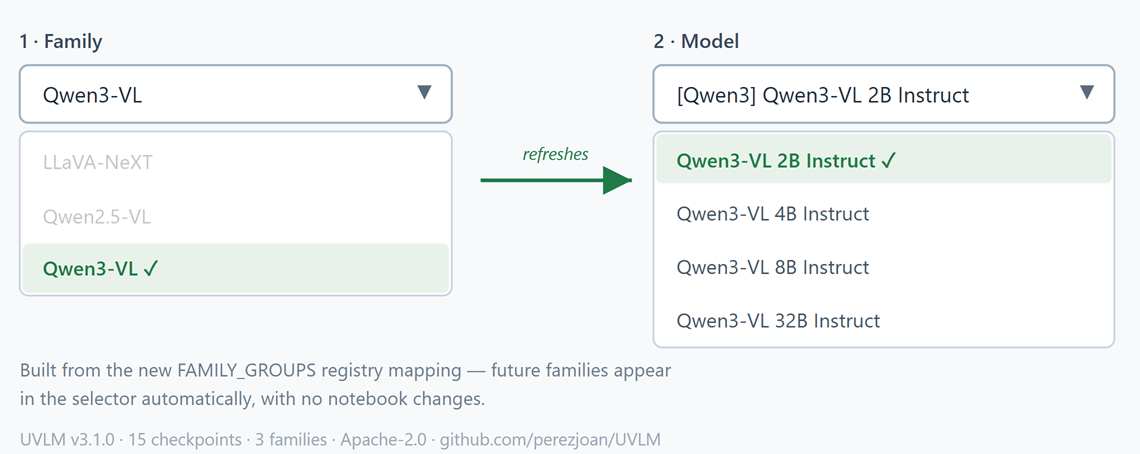
The selector is built from a new FAMILY_GROUPS mapping in the registry, which means future families will appear in the widgets automatically, with no notebook edits at all.
Smarter precision handling
Qwen3-VL checkpoints are trained in BF16. On GPUs with native BF16 support (RTX 30-series and newer, L4, A100), the loader now selects BF16 automatically, falling back to FP16 on older cards and FP32 on CPU. If you followed our earlier benchmark work, you may remember the FP16 numerical-overflow crashes we documented with BF16-trained checkpoints on T4 hardware — this release is the first step toward closing that class of problem at the loader level.
Quality-of-life fixes
Local Jupyter users get a long-overdue improvement: the model-loading progress (download bars, device map, timings) is now displayed in a log area under the Load button. Previously, output emitted inside the widget callback was silently swallowed in local Jupyter — Colab was never affected. The release also silences the torch_dtype deprecation warnings from recent Transformers versions and synchronizes the package version metadata.
Nothing changes in the workflow — install (or upgrade) and the new family is there:
pip install --upgrade --force-reinstall --no-deps git+https://github.com/perezjoan/UVLM.git
Or open the Colab notebook — it always installs the latest version automatically. The three-block workflow (load → configure tasks → run batch), consensus validation, chain-of-thought mode, and truncation detection all work with Qwen3-VL out of the box. Tested locally on Windows 11 with an RTX 5060 laptop GPU, where the 2B model loads in well under a minute once cached.
What’s next
v3.1.0 is the first of a series of family additions. Next on the roadmap: InternVL3.5 (via the Transformers-native -HF checkpoints) and the Gemma multimodal line. Each family will land as its own validated release — same discipline, one backend at a time.
Full change log in VERSIONS.txt · Source and releases on GitHub · If you use UVLM in research, please cite our Software paper.
Table of contents
Leave A Comment