
Connected devices • Smart contracts • Decentralised compute • Web3 infrastructure
THE VISION
Trusted Data, Decentralised Intelligence
The convergence of spatial data, connected devices, and decentralised infrastructure is creating new possibilities for how urban data is collected, validated, shared, and processed. Blockchain protocols provide immutable audit trails and programmable governance. IoT networks provide real-time spatial sensing. Decentralised compute platforms provide censorship-resistant, privacy-preserving AI inference. Together, they form an infrastructure layer that is fundamentally different from the centralised cloud model — one where data provenance is verifiable, access is programmable, and processing is distributed.
Urban Geo Analytics designs and deploys systems at this intersection. We are not blockchain evangelists — we are engineers who use decentralised technology where it solves real problems: data integrity, multi-stakeholder trust, censorship resistance, cost optimisation, and sovereignty over sensitive data and models.
IOT & BLOCKCHAIN SERVICES
Connected Devices, On-Chain Data, Programmable Governance
Sensor Integration & Spatial IoT
We connect IoT devices — environmental sensors, traffic counters, air quality monitors, weather stations, noise meters — to geospatial data pipelines. Sensor readings are geo-referenced, timestamped, and fed into structured databases or blockchain registries. The result is a live spatial data layer that updates in real time, ready for analysis, visualisation, or triggering automated actions. We handle device configuration, data ingestion protocols (MQTT, HTTP, LoRaWAN), and integration with existing GIS and analytics platforms.
Blockchain-Registered Geospatial Data
For applications where data integrity is critical — field surveys, crowdsourced mapping, environmental compliance monitoring, research data management — we notarise geospatial data entries on-chain. Each record receives an immutable timestamp, a cryptographic hash, and a verifiable provenance trail. We work with Ethereum, Polygon, cosmos, and Solana depending on the cost, speed, and ecosystem requirements of the project. Smart contracts manage conditional data access, automated sharing agreements, and decentralised governance for multi-stakeholder spatial data platforms.
Decentralised Storage
Large geospatial datasets — satellite imagery, point clouds, street-view archives — can be stored on IPFS or Filecoin for persistent, content-addressed, censorship-resistant hosting. We configure pinning services, manage retrieval performance, and integrate decentralised storage with conventional data pipelines so that the storage layer is transparent to end users and downstream applications.
DECENTRALIZED AI DEPLOYMENT
Running AI Models on Web3 Infrastructure
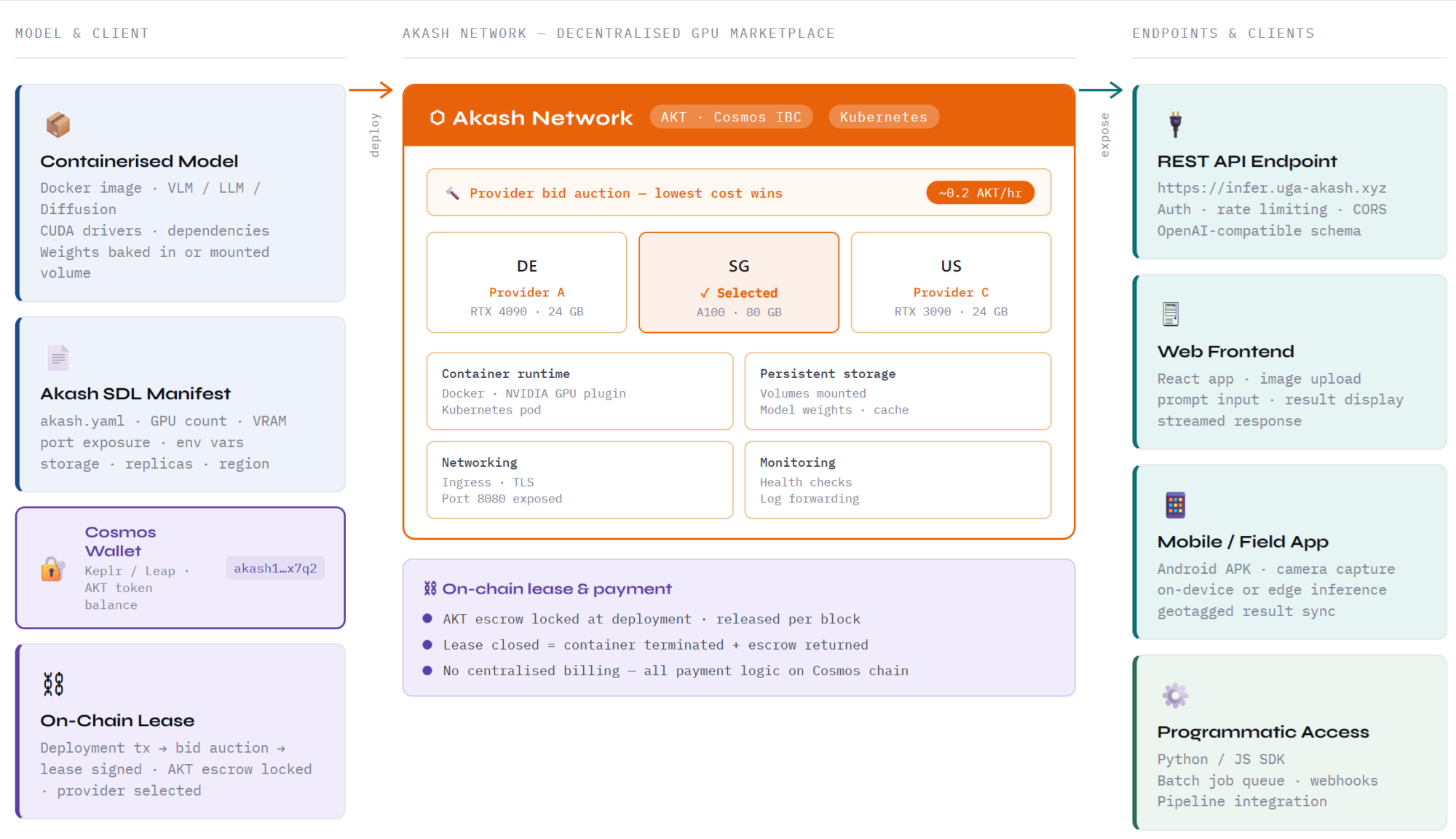
Beyond traditional cloud hosting, UGA deploys AI models — VLMs, LLMs, diffusion models — on decentralised compute networks. Platforms like Akash operate as open GPU marketplaces where compute resources are provisioned through blockchain-based bidding rather than centralised provider contracts. This approach offers tangible advantages for certain deployment scenarios.
Cost efficiency is often the most immediate benefit: decentralised GPU marketplaces frequently provide compute at a fraction of hyperscaler pricing, particularly for sustained inference workloads that do not require burst capacity. Censorship resistance ensures that no single provider can restrict access to your deployed models — inference endpoints remain available regardless of platform policy changes, terms-of-service shifts, or geopolitical access restrictions. Privacy and sovereignty are addressed by deploying models on nodes in specific jurisdictions, optionally combined with encrypted inference for sensitive data. Redundancy comes from distributing inference across multiple independent providers, eliminating single points of failure.
We handle the full deployment pipeline: containerising models (Docker), configuring Akash SDL manifests, managing persistent storage volumes, and setting up API gateways with authentication, rate limiting, and monitoring. The client interacts with a standard REST endpoint — the decentralised infrastructure is entirely transparent. We also provide cost modelling to compare decentralised deployment against equivalent cloud configurations, so the decision is evidence-based.
USE CASES
Where Decentralised Infrastructure Creates Value
Crowdsourced mapping with cryptographic validation: field-collected geodata notarised on-chain with proof of who collected what, when, and where. Environmental sensing networks: IoT sensors feeding real-time data to blockchain-timestamped registries for tamper-proof environmental monitoring. Decentralised AI inference: VLM, LLM, or diffusion model endpoints deployed on Akash for cost-optimised, censorship-resistant, privacy-preserving inference. DAO-based urban experiments: community governance of urban data and budgets through smart contract-mediated decision-making tied to real-world spatial assets. And at the frontier of digital culture, NFT and spatial storytelling: tokenised urban imagery, generative art from geospatial data, and metaverse galleries exploring the intersection of digital art, identity, and urban space.
Interested in decentralised infrastructure for your data or AI systems? Get in touch.