
Spatial analytics • Urban morphometrics • Accessibility modelling • Custom tool development
THE CONTEXT
Spatial Data as Decision Infrastructure
Cities generate vast amounts of spatial data — from building footprints and street networks to satellite imagery, census grids, and real-time sensor feeds. Turning this data into actionable intelligence requires not just technical capacity but deep understanding of urban systems: how accessibility shapes neighbourhoods, how morphology influences liveability, how networks determine connectivity, and how these relationships change across scales and contexts.
Urban Geo Analytics combines geospatial engineering with urban science. We do not simply process spatial data — we design analytical frameworks grounded in geographic theory and validated through peer-reviewed research. This dual foundation means our tools produce outputs that are not only technically correct but scientifically meaningful: indicators that planners can trust, models that researchers can cite, and maps that decision-makers can act on.
GEOSPATIAL TOOL DEVELOPMENT
Custom Pipelines, Interactive Maps, Hosted Platforms
End-to-End Data Pipelines
We design and build complete workflows for geospatial data acquisition, cleaning, enrichment, analysis, and visualisation. Our pipelines typically combine Python scripting (OSMnx, GeoPandas, Shapely, Rasterio) with QGIS processing and Google Earth Engine for remote sensing data. Everything is modular: clients can run the full pipeline or integrate individual components into their own systems. We deliver documented Jupyter notebooks, standalone scripts, or production-ready packages depending on the deployment context.
Automated Data Acquisition
Many geospatial projects begin with data that does not yet exist in structured form. We build automated extraction pipelines that pull geodata from public sources, APIs, and web platforms — OpenStreetMap, national cadastres, open government portals, Google APIs, satellite imagery archives — and deliver it as clean, analysis-ready datasets in GeoPackage, GeoJSON, or database-ready formats. This includes advanced web scraping, API orchestration, and data mining techniques that go beyond what standard GIS tools offer out of the box.
Interactive Maps & Dashboards
We build web-based visualisation tools using Folium, Leaflet, Mapbox, or Deck.gl, deployed as standalone applications or embedded in the client’s existing platforms. These range from simple thematic maps for report illustration to full interactive dashboards with filtering, layer toggling, spatial queries, and dynamic indicator computation. For enterprise clients, we deploy secure, production-ready interfaces on cloud or on-premise servers with authentication, role-based access, and data refresh pipelines.
Example of a Map deployed for the e-Geopolis Institute®
URBAN MORPHOMETRICS & PLANNING ANALYSIS
Network Analysis, Accessibility, and Spatial Classification
Accessibility Modelling
We compute pedestrian sheds, isochrone maps, and network-based catchment areas that reflect how people actually move through cities — along the street network, not as Euclidean buffers. Our PPCA protocol combines OpenStreetMap network data with Global Human Settlement population rasters to produce walking-distance population potential at any scale, anywhere in the world. This supports 15-minute city analysis, service coverage assessment, and equity evaluation across metropolitan areas.
Morphometric Classification
Using machine learning on morphometric features (building area, perimeter, elongation, compactness, height, floor area ratio), we classify building typologies, cluster urban fabrics, and identify spatial patterns that are invisible to manual inspection. Decision trees, random forests, and unsupervised clustering applied to millions of buildings can reveal the spatial logic of a city — where residential, commercial, and industrial tissues meet, how neighbourhood character varies across districts, and where transitions or anomalies occur.
Network Analysis & Spatial Equity
Street connectivity, centrality indicators, pedestrian route quality, and spatial equity assessment across urban networks. We compute betweenness, closeness, straightness, and reach-based metrics on pedestrian, cycling, and vehicular networks, identifying structural advantages and disadvantages at the neighbourhood, district, and metropolitan scale. These indicators feed directly into planning diagnostics, policy evaluation, and investment prioritisation.
Calculation of indicators and Map Deployment for Region Sud (France)
LLMs & AGENTS FOR SPATIAL ANALYSIS
Language Models and Autonomous Agents for Urban Data
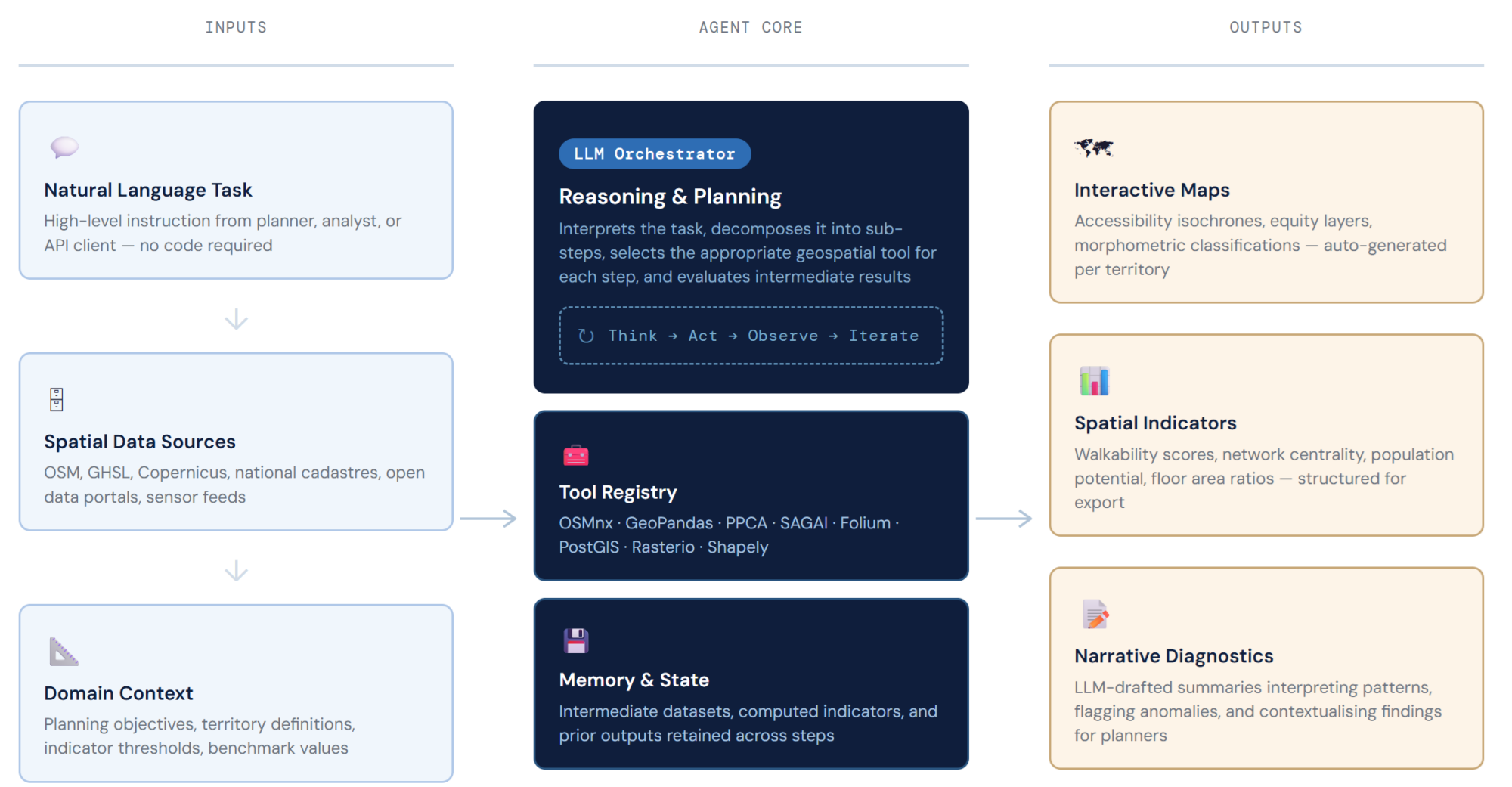
The rise of large language models (LLMs) and AI agent frameworks introduces a new layer of intelligence on top of traditional geospatial pipelines. Where conventional GIS workflows process spatial data through fixed, manually-authored sequences of operations, language models and agents can interpret natural language instructions, select and invoke the appropriate tools, and iterate autonomously toward an analytical objective — fundamentally changing what it means to interact with and extract insight from spatial data. These models and agents can run entirely on the client’s infrastructure: see Local & Private LLMs & Agents.
LLMs as a Natural Language Interface to Geospatial Data
LLMs can serve as a conversational interface to spatial databases and geospatial APIs. A planner who wants to know which census blocks within a 15-minute walk of a transit hub have above-average elderly populations and below-average green space coverage does not need to write a spatial query or navigate a GIS interface — they can ask in natural language. We build connectors that translate plain-language questions into structured spatial queries (PostGIS, GeoPandas, OSMnx), execute them against the appropriate data source, and return answers with accompanying map outputs.
Beyond query interfaces, LLMs also serve as automated narrators: given a set of indicators and a map, a language model can draft a spatial diagnostic — summarising patterns, flagging anomalies, and contextualising findings relative to benchmarks or planning objectives. This is particularly useful for producing standardised reports across large numbers of territories or for assisting teams who are expert in urban policy but not in spatial data science.
Autonomous Agents for Geospatial Workflows
An AI agent is an LLM connected to a set of tools — functions it can call, APIs it can query, scripts it can run — and structured to pursue a goal through a sequence of reasoning and action steps. Applied to spatial data, an agent can receive a high-level task (“produce an accessibility diagnostic for the five districts with the lowest walkability scores in this region”), decompose it into sub-tasks (fetch network data, compute isochrones, overlay population, rank districts, generate maps, draft summary text), execute each step using the appropriate geospatial tool, and iterate when intermediate results require adjustment — without human intervention at each step.
We build spatial agent frameworks in Python using LangChain and custom tool registries that expose our geospatial pipelines as callable functions. The agent’s tool set typically includes: OpenStreetMap data retrieval (OSMnx), population and land-use raster queries (GHSL, Copernicus), morphometric indicator computation, network analysis (accessibility, centrality), spatial join and overlay operations, and map output generation (Folium, Deck.gl). The LLM — operating as the orchestrator — decides which tools to call, in what order, and how to interpret intermediate results to proceed toward the final output.
What This Enables in Practice
Automated urban diagnostics: given a list of territories, an agent produces a standardised report for each — accessibility indicators, morphometric profile, equity analysis — without manual configuration per territory. Multi-city benchmarking: an agent retrieves, harmonises, and analyses comparable data for a set of cities, producing a comparative ranking with narrative interpretation. Conversational GIS for non-specialists: planners, elected officials, or community groups interact with spatial data through a chat interface, asking questions and receiving map answers without requiring GIS training. Monitoring and alert systems: an agent periodically queries spatial data sources (satellite, open data portals, sensor feeds), computes indicators, and flags significant changes or threshold breaches for human review.
OPEN-SOURCE FOUNDATION
Backed by SAGAI, PPCA, UVLM, etc.
Our geospatial capabilities are built on open-source tools we develop and maintain: PPCA for population accessibility analysis, SAGAI for streetscape analysis with generative AI, UVLM for vision language models, etc. These tools — both published in peer-reviewed journals — demonstrate the methodologies we deploy in production for clients.
Need spatial analysis, urban modelling, or a custom geospatial tool? Get in touch.