
Software & Algorithms
Diffusion Pipelines for Urban Scene Editing
This project provides a set of open-source, fully local workflows for text-guided transformation of architectural and urban scenes. Built on ComfyUI and diffusion-based image editing models (currently Qwen-Image-Edit in GGUF format), the pipelines allow natural-language manipulation of urban imagery — without any reliance on cloud APIs, external GPUs, or proprietary services.
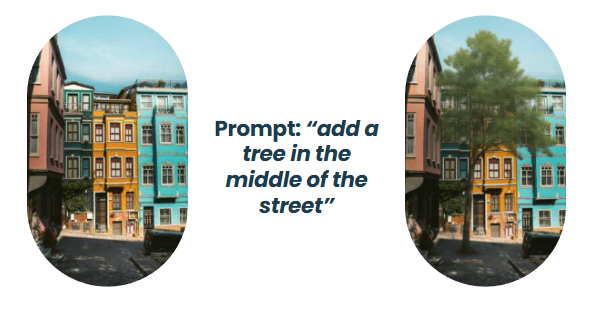
Streetscape Analysis with Generative AI (SAGAI)
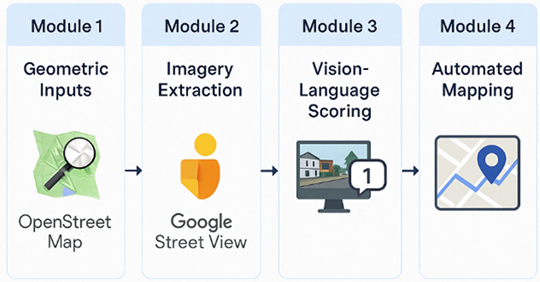
SAGAI is an open-source, modular workflow for scoring and mapping street-level urban environments using generative vision-language models—specifically a lightweight version of LLaVA (Large Language and Vision Assistant). It enables scalable, prompt-driven interpretation of Google Street View imagery using only a geographic bounding box—requiring no pre-labeled data, specialized hardware, or deep learning expertise.
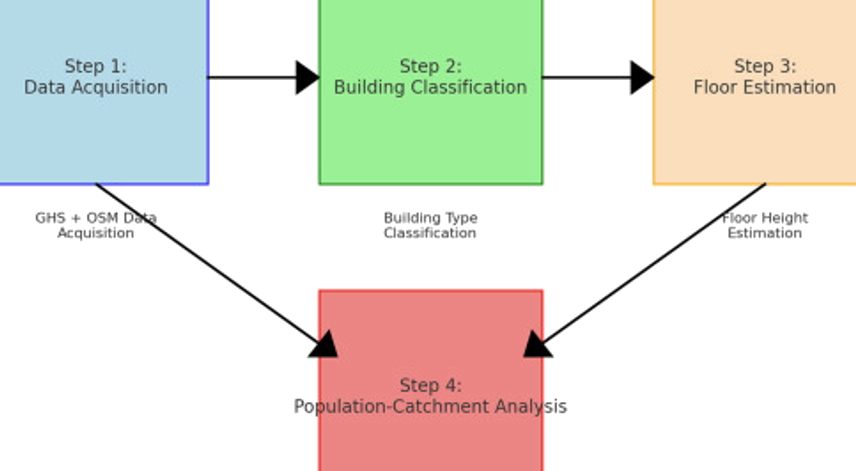
PPCA: Population Potential on Catchment Area
The PPCA (Population Potential on Catchment Areas) protocol is a four-step procedure for acquiring, processing, and analyzing geospatial data from OpenStreetMap (OSM) and Global Human Settlement (GHS) data using Python and associated libraries. The project aims to evaluate the potential number of people accessible on foot within specified proximity catchment areas. The protocol works globally by requiring only bounding box coordinates instead of sample data.
UVLM: Universal Vision-Language Model Loader
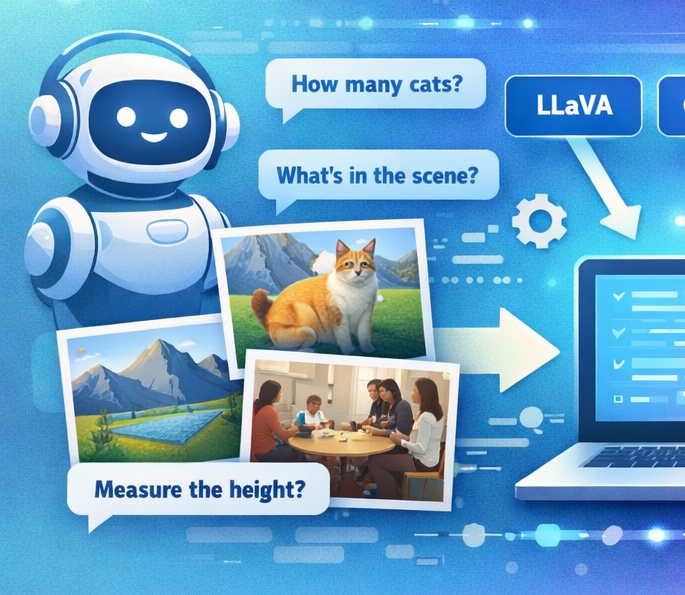
UVLM is an open-source framework that provides a unified interface for loading, configuring, and benchmarking multiple Vision-Language Model (VLM) architectures on custom image analysis tasks. It abstracts the substantial architectural differences between VLM families behind a single inference function, enabling researchers and practitioners to compare models using identical prompts and evaluation protocols — without writing model-specific code.